

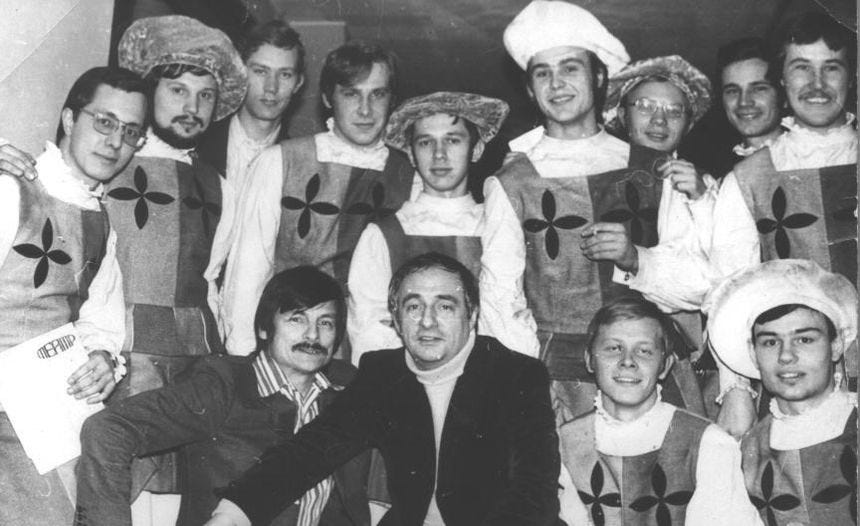
It is likely that Tarkovsky’s next film could’ve been ‘Hamlet’. He loved the play so much he actually directed a theater performance with Anatoly Solonytsin as the lead; the only one play he ever directed. He praised it on interesting grounds, that is, Hamlet’s indecision was based on refusing to debase himself morally, so that his death at the end comes as a self defeat after his moral failure by murder.
It is the basis, too, of my interest in Hamlet, of which I hope to make a film sooner or later. This greatest of dramas sets out the eternal problem of the man who is of higher moral stature than his peers, but whose actions necessarily affect and are affected by the ignoble real world. It is as if a man of the future were forced to live in the past. And Hamlet’s tragedy, as I see it, lies not in his death but in the fact that before he dies he is obliged to renounce his own quest for perfection and become an ordinary murderer. After that, death can only be a welcome way out—otherwise he would have had to kill himself . . .
I think it’s interesting that he would interpret Hamlet in such idealistic way, in a sense disregarding the main conflict of the character, doubt, but I can see how he could adapt it successfully to his own ideals. What interests me is precisely how this conception ties into his own life. Certainly this way of describing Hamlet is near to a close projection of his experience working in the film industry while maintaining and promoting “a higher moral stature” (at least artistically, as he’s reputed to have left many Ophelias behind among other victims).
But the most fascinating tie for me is the legend around a prophecy made to Tarkovsky. Apparently he assisted a seance where they invoked the ghost of Boris Pasternak, famous Russian poet, where he informed Andrei that he would only make seven films (which he did). With Tarkovsky’s father being a renowned poet himself, there seems to be a definite echo with Hamlet and the ghostly apparition of his father, which in a sense establishes a sacred responsibility or fate. Which to me feels like Tarkovsky couldn’t film 'Hamlet’ because he was living it, except in his version Hamlet always answers: To be!
Still, we have some of the notes for filming “Hamlet” in his collection of diaries Martyrology:
2 March, Via di Monserrato
[...] For Hamlet: If it was possible to find a way to express on film the idea of succession and gratitude of the offspring (the four captains) then one could give up the entire thread of Fortinbras. [...]
Hamlet.
King — Erland Josephson, ghost of the father — Max von Sydow.
The castle’s wing is in ruins, each room more devastated than the previous one. And it is in the last one, overgrown with bushes, with no roof, that Hamlet meets the ghost of his father. During the day (although the passage will begin at night, in the darkness) under the glaring light when one can see the tiniest wrinkles on his face. The face from the side, eyes remain invisible. One can very clearly see the cheek and the ear from which pus is oozing out. Immediately after this — a long shot. (The ghost warms himself up by the smoky fire.)3 March, Friday, Via di Monserrato
Hamlet.
The battle: the first shot from the helicopter. An especially selected and fitting object. It is necessary to invent a completely new not so much a concept but a construction, an idea, creating it according to one’s own interpretation. [...]16 March, Wednesday, Via di Monserrato
Tell Hamlet in a language that’s modern in every respect. Show the essence of the contrast through images, and in the first place of course, through Hamlet’s character. Here the dramaturgy is nothing but dialectical, however.
Yankovsky — Hamlet? This could be quite good. [...]20 November, Sunday, San Gregorio
[...] Hamlet.
They are looking for Ophelia who drowned. They are draining the ponds. People in water, it runs out gradually revealing the bottom of the pond and the crimes of Elsinore. They find Ophelia, her eyes are open.
A slippery, damp layer at the bottom. Ophelia’s dress is white, with lace. Cloth through which all the water in the pond has passed. A fish flutters in the lace mesh — of life!?
Two fragments; no — three (!):
1. draining the water,
2. the drowned woman,
3. proofs of guilt at the bottom of the pond..
Yorick’s skull is not found by the gravediggers but at the bottom of the pond. Yorick was murdered.
Must urgently find the translation of Hamlet by Morozov. [...]22 November, San Gregorio
[...] Hamlet — or a portion of it at least — should be filmed in Monument Valley. It’s astonishing that in places like this, where one ought to talk to God, Americans make westerns like John Ford used to do. [...]25 September
[...] Why does Hamlet seek revenge? Revenge is a way of expressing family blood ties, a sacrifice made for those near and dear, a sacred obligation. Hamlet, as we know, avenged to join "the broken link of times," or rather to realise the idea of self-sacrifice. Persistence or obstinacy is frequently apparent in actions which only hurt the person who undertakes them — this is a perverted form of sacrifice. Self-negation, obligation.
Odd, absurd moments of necessity, of propriety of sacrifice which the materialist Freud would call "masochism." A religious person — "obligation." Dostoievsky called it "desire to suffer." Without a religious system such desire to suffer may turn into psychosis. Ultimately, it is love that hasn't found form. But this is spiritual love, not a Freudian one. Love is always a gift made of oneself to others. And although generosity, readiness to make a sacrifice, carries within itself as it were a negative, ostensibly destructive meaning (naturally, in its vulgar understanding) in relation to the individual who makes the sacrifice of himself, the essence of this act is always love, and therefore a positive, creative, divine act. [...]
I think the problem of Hamlet could be stated more precisely in the frame of Stalker: what would happen if Hamlet walked into the room? Would he get his revenge, escape it or save Ophelia? Hamlet’s problem is doubt, he does not know what he wants. I think this would’ve been the proper adaptation of Hamlet, even though Sacrifice gets pretty close, with Alexander saying “I finally understand Hamlet”, where the the main action follows both tensions: the actor who through doubt stops acting versus the one that through faith orders the state of things.
Benno!
Hamlet in the room. Maybe he would get a book that would have answers to all the questions he has.
Never seen a Tarkovsky film in my life, just here to support your work 👍