

Attention, ladies and gentlemen, one moment of your attention:
For an instant turn your gaze towards this side of the republic,
Forget for one night all your personal matters,
Pain and pleasure can wait at the door:
A voice is heard from this side of the republic.
Attention! Ladies and gentlemen! One moment of your attention!
A soul that has been bottled through years
In a a sort of psycho-sexual abyss,
Scarcely feeding itself from the nose,
Wishes to be heard.
I wish to be informed upon certain matters,
I need a little bit of light, the garden's getting covered with flies,
I find myself in a disastrous state of mind,
I reason according to my logic;
As I say these things I see a bicycle resting on a wall,
I see a bridge
And a car that disappears between buildings.
You all fix your hair, that's true, walk barefoot through gardens,
And under your skin you have another skin,
You possess a seventh sense
That allows you to enter and exit automatically.
But I'm an infant that calls to his mother behind the rocks,
I'm a pilgrim that makes stones jump to the heights of his nose,
A tree that demands with cries to be covered with leafs.
Nicanor Parra is a Chilean poet, he studied math and physics, maybe one could be tempted to call him an anti-poet considering he referred to his word assemblies as anti-poems. As a mathematician it’s hard to say what an anti-poem could be structurally, since the definition of poetry is almost the opposite of a definition, it’s the anti-definition of things. There’s also a temptation to search for the operation of which the anti-poem is the inverse negative, I think it’s everyone’s interest to find the poetical annihilation of such a process.
In this poem we at least see the operations that are involved regarding the nose, establishing a relationship between stones and food, height’s and scarcity; that is, poetical inverses. The seventh sense seems to be equally connected to the nose, the only sensual part that is bi-directional.
This is Roberto Bolaño on Parra (I have mutilated the text, and ponder what would be considered treachery in translation, and can only come up with: being obvious about your treachery):
Let whoever is brave follow Parra. Only the young are brave, only the young have the pure spirit among the pure. But Parra does not write youthful poetry. Parra does not write about purity. He does write about pain and solitude; about useless yet necessary challenges; about words condemned to disintegrate just as the tribe is also condemned to disintegrate. Parra writes as if he were going to be electrocuted the next day. The Mexican poet Mario Santiago, as far as I know, was the only one who made a lucid reading of his work. The rest of us have only seen a dark meteorite. First requirement of a masterpiece: to go unnoticed.”
...nor the zombies strolling through the village of Santiago {I think it’s important to jump here to remark the importance of the city and poet, Bolaño’s friend, being namesakes} have been able to take him down. Not even Parra’s followers have been able to take him down. In fact, I would say—surely carried away by enthusiasm—that not only Parra, but also his siblings, with Violeta at the forefront, and his Rabelaisian parents, have put into practice one of the greatest ambitions of poetry throughout the ages: to annoy the hell out of the public.”{This hyperbole by Bolaño is a clue to why he never succeeded as a poet}
“Verses taken at random. It is a mistake to believe that the stars can be used to cure cancer, said Parra. {I’m not sure, but I do think they can cause cancer} He has more sense than a saint. By the way, regarding shotguns, I remind you that the soul is immortal, said Parra. {What I think is relevant is to ponder the immortality (and immorality) of shotguns} He has more sense than a saint. And we could go on like this until no one is left. Anyway, I remind you that Parra is also a sculptor. Or a visual artist. These clarifications are perfectly useless. Parra is also a literary critic. Once he summed up the entire history of Chilean literature in three lines. They are these: ‘The four great poets of Chile / Are three / Alonso de Ercilla and Rubén Darío.’”{Note to self: read Alonso de Ercilla}
“The poetry of the first decades of the 21st century will be hybrid poetry, as narrative already is. {It is important here to mention, re: the def of poetry, that it is always hybrid} We are possibly heading, with terrifying slowness, toward new formal tremors {We’re past the first quarter of the 21st century, the formal tremors is precisely the corpse of the 20th century that smells}. In that uncertain future, our children will witness the encounter on an operating table of the poet sleeping in a chair with the black bird of the desert, the one that feeds on the parasites of camels{This is correct}. On one occasion, in the last years of his life, Breton spoke of the need for surrealism to go underground, to plunge into the sewers of cities and libraries. He never touched on the subject again. It doesn’t matter who said it: The time to settle down will never come.” {He never touched the subject again because he went to Mexico (Nicanor Parra outlived Roberto Bolaño by 15 years and died a 103 years old, more than double Bolaño’s 50, his coffin had written on it: «Voy&Vuelvo» )}
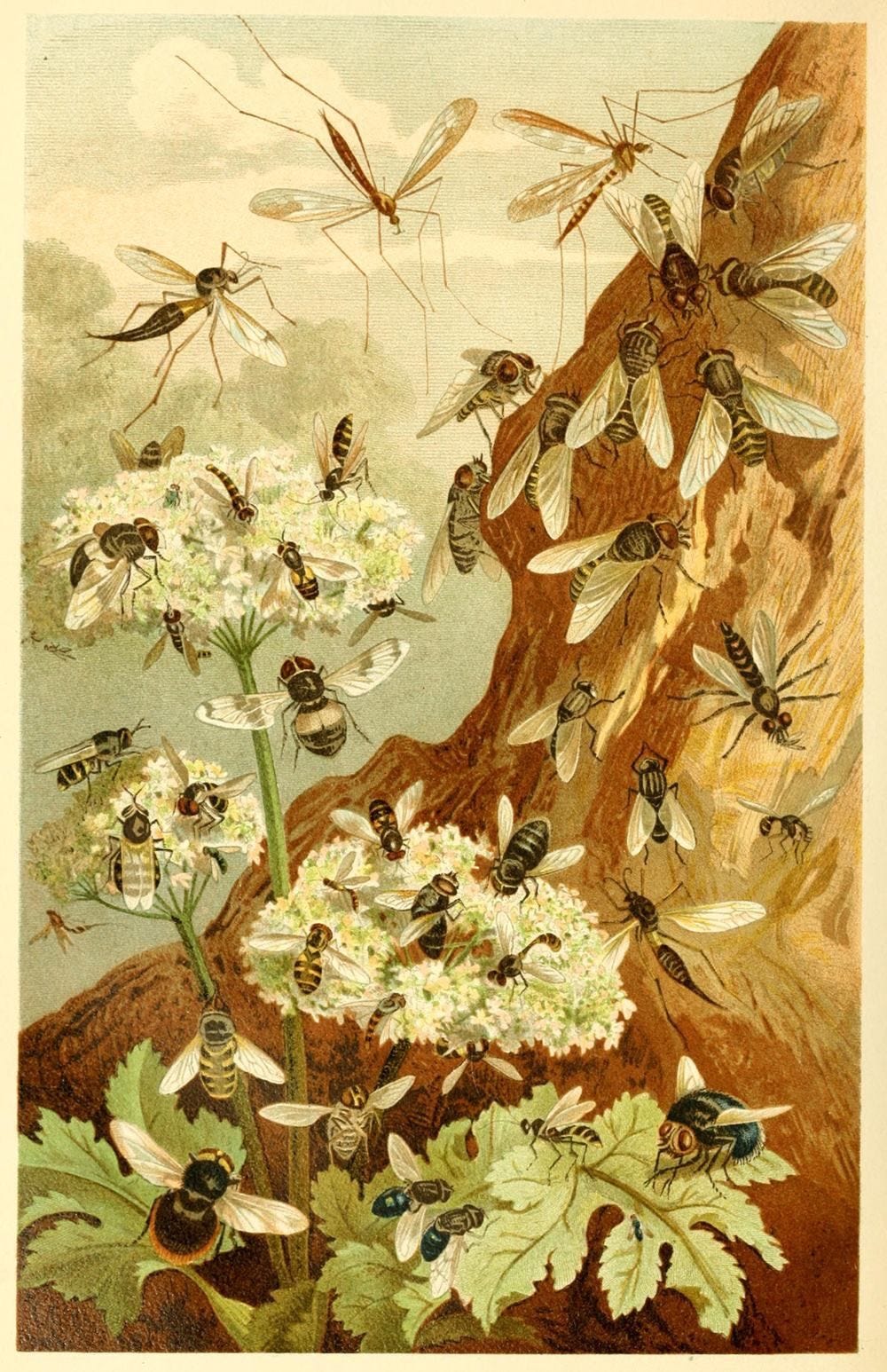
Die Insekten, Tausendfüssler und Spinnen Alfred Edmund Brehm
Ah. People had told me before that Violeta Parra's brother was a poet, but this is the first time I've read him. Really wonderful piece. Thanks for sharing.
Benno! Loved the text part of this post! Especially how it was introduced, "... (I have mutilated the text, and ponder what would be considered treachery in translation, and can only come up with: being obvious about your treachery)" that was fun.
I also like all the fragments in {}, most of them made me chuckle.
Hope you are doing well!